For the first two years of making things, my “craft studio” was the dining table. Which meant every project involved twenty minutes of setup and twenty minutes of cleanup, and my flatmate learned to tolerate finding glitter in his cereal.
It wasn’t sustainable. So I carved out an actual craft space; not a whole room (I don’t have one to spare), but a dedicated corner that stays set up and ready to go. It cost me less than €100 to put together, and it completely changed how often I actually make things.
Here’s exactly how I did it, and how you can set up something similar regardless of your space or budget.
Step 1: Claim Your Space
You don’t need a room. You need a corner. Specifically, you need about 1.2 metres of wall space and enough floor area for a small desk or table. That’s it.
Places I’ve seen people set up brilliant craft spaces:
- A corner of the bedroom (my current setup)
- Under a staircase (a friend of mine did this and it’s genius)
- Inside a wardrobe: open the doors and the whole interior becomes your workspace, close the doors and it disappears
- A section of the garage or garden shed
- A rolling cart that tucks into a closet when not in use
The only non-negotiable requirement is natural light for at least part of the day. Crafting under pure artificial light is miserable and makes colour-matching impossible.
Step 2: Choose Your Work Surface
This is the foundation. Here’s what I’ve tried and what I’d actually recommend:
Budget Options (Under €40)
IKEA LINNMON tabletop + ADILS legs: This is my actual desk. The 120×60cm size is perfect, and the whole thing costs about €25-30. It’s not beautiful, but it’s functional and if you ruin it with paint stains, you’ve lost thirty euros, not three hundred.
A folding table: if space is truly tight, a folding table you can lean against the wall when not in use is completely legitimate. No shame in it.
A secondhand desk: check Facebook Marketplace or local charity shops. I’ve seen solid wood desks go for €10-20 because someone was moving and didn’t want to haul furniture.
Splurge Option (€80-150)
A height-adjustable desk: Sounds excessive for crafting, but being able to stand while cutting fabric or painting is genuinely useful for longer sessions. Your back will thank you. IKEA’s SKARSTA is the cheapest manual crank option at around €120.

Step 3: Storage That Actually Works
Here’s what I’ve learned the hard way: visible, open storage beats closed storage for craft supplies. If you can’t see it, you forget you have it and buy duplicates. (I currently own four bottles of the same shade of acrylic paint. Don’t be me.)
My Favourite Storage Solutions
- Pegboard on the wall above your desk (€15-20 at any hardware store). Add hooks for scissors, tape, rolls of twine. This single purchase made the biggest difference to my workspace.
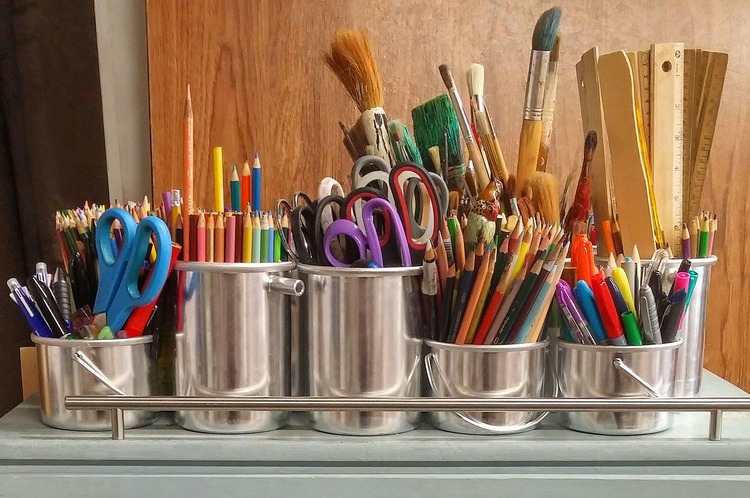
- Mason jars or old jam jars screwed to a shelf or just lined up in a row. Perfect for buttons, beads, small hardware, markers.
- A rolling cart — the IKEA RÅSKOG (about €30) is absurdly popular for a reason. Three tiers of open storage that you can wheel to wherever you’re working.
- Clear plastic bins with labels. I use the IKEA SAMLA range: cheap, stackable, and you can see what’s inside.
What NOT to Buy
Skip the expensive “craft organiser” systems marketed on Pinterest. They’re beautiful in photos and useless in practice because they’re designed for people who store supplies, not people who use them. You want easy access, not museum display.
Step 4: Lighting
If your natural light situation isn’t great, invest in one decent lamp. A daylight LED desk lamp (5000-6500K colour temperature) costs €20-35 and makes an enormous difference, especially for sewing, painting, or anything requiring colour accuracy.
Avoid warm-toned lamps (3000K or below) as your primary work light. They make everything look yellowish and you’ll misjudge every colour you mix.
Step 5: The Supplies Starter Kit
If you’re setting up from scratch and don’t know what to buy first, here’s the essentials list I wish someone had given me:
| Category | Must-Haves | Approximate Cost |
| Cutting | Sharp scissors (fabric + paper — keep them separate), craft knife, self-healing cutting mat | €20-25 |
| Adhesives | Hot glue gun + sticks, Mod Podge, double-sided tape, white PVA glue | €15 |
| Painting | Basic acrylic paint set (12 colours), 3 brush sizes, palette or paper plate | €10-15 |
| Measuring | Metal ruler, measuring tape, pencils | €5 |
| Misc | Twine, washi tape, a few sheets of cardstock | €5-8 |
| Total | €55-68 |
You can absolutely start with less than this. I started with scissors, a glue gun, and whatever I could find in the kitchen junk drawer.

My Actual Setup (Real Talk)
I won’t pretend my studio is Instagram-worthy. The desk has paint marks on it. There’s a shoebox labeled “THINGS I DON’T KNOW WHERE TO PUT” that’s been sitting there for months. The pegboard is slightly crooked because I hung it myself and measuring is apparently harder than it looks.
But it works. When I feel like making something, I sit down and start. No setup, no cleanup drama, no displaced flatmate. That accessibility is the whole point.
For inspiration on what to actually make in your new space, check out my list of DIY gift ideas you can make at home. And if you’re redoing the room around your craft corner, my post on budget room makeovers under €100 has some practical ideas.